INEC chairman Amupitan says the commission will obey the Supreme Court on whether Atiku can be on the 2027 ballot
Speaking at Chatham House in London, the INEC chairman said Section 285 of the Constitution binds the commission, and that more than 300 court cases are pending 66 days before the vote.

The chairman of the Independent National Electoral Commission, Prof. Joash Amupitan, says the commission will obey whatever the Supreme Court finally decides on whether former Vice-President Atiku Abubakar can contest the 2027 presidential election on the platform of the African Democratic Congress (ADC). He spoke on Thursday in London, according to reports by Arise News, Galaxy Television, Punch and TheNiche.
Amupitan was answering a question from a Semafor Africa representative at a dialogue at Chatham House, organised with the Kimpact Development Initiative under the theme “Nigeria's 2027 Elections: Democratic Trajectory and Regional Stability Beyond the Ballot”. The question was whether Atiku would still be allowed to run if he fails to overturn a Federal High Court judgment affecting the ADC.
“If it travels through the courts and, as you said, he eventually fails, well, I'm obligated under section 285 of the Constitution of Nigeria to obey every court order, especially if it is from the Supreme Court,” the INEC chairman said. TheNiche reported his answer as meaning Atiku would not be on the ballot if he fails to overturn the judgment, while the other outlets quoted the same words without that framing.
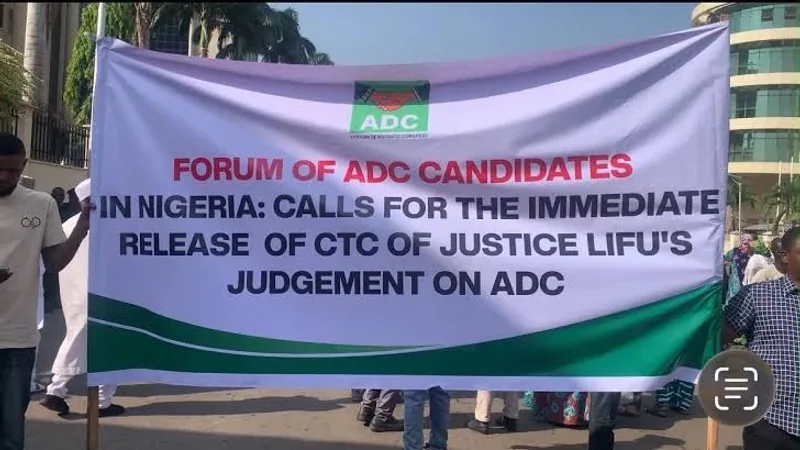
The judgment in question was delivered on 5 November 2026 by Justice Peter Lifu of the Federal High Court in Abuja. It nullified the leadership of the ADC led by former Senate President David Mark, declaring the process that produced Mark and other national officers unlawful. Atiku emerged as the ADC's presidential candidate under that leadership. TheNiche reported that the Mark faction has vowed to pursue the matter so that Atiku stays on the ballot for the 16 January presidential election.
Amupitan said INEC had asked for a fast hearing when the ADC leadership dispute emerged in April. “When it happened in April, the position of the commission was that the matter should be resolved within three weeks,” he said. He added that INEC complied with a court directive to suspend action and wait for the outcome of the case, which later went on appeal.
He also admitted that carrying out a politically sensitive order can put the commission under fire. “The danger is that whenever there's such a decision, and it's you who now has to implement it, you become the problem,” he said. “The problem now is transferred to you. But that is the position of the law.”
The chairman used the occasion to complain about the volume of litigation facing INEC. “Over 300 court cases hanging on the neck of INEC, and elections is just about 66 days away,” he said. He said INEC has already started procuring sensitive election materials, and repeated his earlier call for pre-election disputes to be settled at least six months, and ideally a year, before polling day so the commission can finish its logistics without uncertainty.
The ADC leadership crisis dates back to 2025, when the resignation of its former national chairman, Ralph Nwosu, was followed by a caretaker leadership under Mark. The party has said the case has slowed its campaign. For now no court has finally ruled on Atiku's candidacy, and Amupitan's comments describe what INEC will do once one does.
SOURCE: Arise News